Article | Intelligent Investment
Behind the Lowest Bid: Why Cheap Facilities Management in Thailand Could Cost You More
November 10, 2026

Today, facilities management in Thailand faces a "procurement paradox." The lower an organization pushes service fees, the higher the hidden risks and damages multiply. For owner-occupiers managing high-value assets—such as corporate headquarters in Bangkok, international schools, industrial plants in the Eastern Economic Corridor (EEC) or leading private hospitals—your facility drives your business. Letting asset preservation fall victim to a race to the bottom requires a serious rethink.
This article uncovers four critical reasons why underpriced facilities management services in Thailand pose a massive risk to your organization, and how shifting to a total cost of ownership (TCO) framework protects your bottom line.
Executive Summary
- Underpriced facilities management services in Thailand may lower monthly fees, but they frequently increase the total cost of ownership through elevated energy consumption, deferred maintenance, emergency repairs and premature capital replacement.
- Low-cost delivery models depend heavily on suppressed labor rates, driving technician turnover that erodes site-specific operational knowledge, slows emergency response times and weakens engineering reliability.
- Tools and software bundled into low-priced contracts offer minimal value when providers lack the qualified engineers and analytical capability needed to turn data into predictive action and measurable performance improvements.
Facilities Management in Thailand: Why Total Cost of Ownership Matters More Than Lowest Price
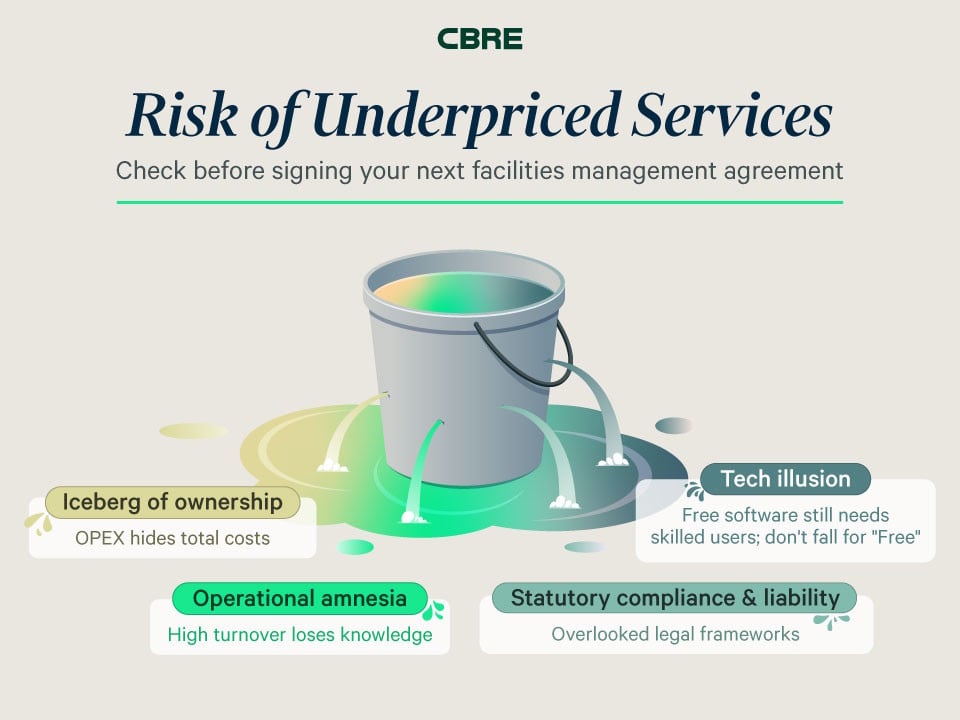
For chief financial officers (CFOs) and procurement leaders, selecting the right provider of facilities management in Thailand requires evaluating the total cost of ownership (TCO) rather than focusing solely on monthly service fees. Global benchmarks from The International Facility Management Association (IFMA) reveal that management fees and baseline labor are just the tip of the iceberg at roughly 10% of total costs.The remaining 90% of the TCO is submerged throughout the broader asset life cycle, comprising utility usage, preventative maintenance, emergency repairs and eventual capital replacement.
Energy Waste: The Inefficiency Tax in a Tropical Climate
In Thailand’s hot and humid climate, electricity is the largest variable cost. Statutory engineering data from the Department of Alternative Energy Development and Efficiency (DEDE) demonstrates that poorly maintained heating, ventilation and air conditioning (HVAC) systems and central chiller plants increase building energy consumption by 15% to 25% above baseline design levels.Eroding CAPEX: Premature Asset Aging
Every piece of MEP (Mechanical, Electrical, Plumbing) equipment has an engineered lifespan. Standardized, high-tier maintenance is crucial to prevent premature deterioration. From a risk management perspective, owner-occupiers must verify that providers deploy legally certified technicians to comply with Thailand's Skill Development Promotion Act (No. 2) B.E. 2557 (2014). Highly specialized tasks require verified technical oversight, including:- Vibration analysis and lifecycle monitoring
- Infrared thermography for electrical switchboards
- Cooling tower chemical water treatment
Strict compliance protects your organization from burning millions in capital expenditure (CAPEX) on premature equipment replacements.
The Reality Check: The minor savings achieved by undercutting monthly service fees can instantly trigger massive costs from skyrocketing energy bills and millions in premature CAPEX due to equipment breakdown without expert maintenance. Opting for a low-cost contract effectively saves 10% at the top, only to inflate risks and damages in the hidden 90% of your operational costs.
Why Low-Cost Facilities Management Services in Thailand Create Operational Amnesia
Low-cost facilities management services in Thailand rely heavily on reducing labor costs to remain competitive during procurement exercises. Inevitably, this strategy triggers severe staff turnover. Price-driven commercial sites face technician turnover rates that directly compromise building engineering systems.The Loss of Institutional Knowledge
When a building technician departs, they take critical, undocumented institutional knowledge with them. This includes unique electrical grid quirks, valve layouts or hidden plumbing leaks omitted from original as-built drawings. New replacements must start from scratch without historical context, drastically delaying response times during critical infrastructure emergencies.The Reality of the Skilled Labor Market
Market data from Mercer's Total Remuneration Survey for Thailand confirms intense competition for technical talent across Southeast Asia. Overall skilled labor wages in Thailand have risen by an average of 5%, with specialized energy engineering and MEP roles climbing by up to 6%. Underpriced contracts cannot provide competitive wages or benefits aligned with these macroeconomic trends.The Reality Check: Squeezing labor rates trades qualified expertise for a revolving door of inexperienced staff. This creates operational amnesia, leaving high-value facilities vulnerable to catastrophic infrastructure downtime because no remaining technician understands the building's undocumented engineering quirks.
The Technology Gap in Facilities Management Services in Thailand
Many low-cost providers of facilities management services in Thailand promote CMMS platforms, dashboards and automation tools as key differentiators. However, this seemingly good deal quickly becomes a liability without the expertise to back it up. Devoid of skilled users, a free or bundled tool quickly devolves into a digital filing cabinet for basic SLA box-checking, proving that the technology itself is only as effective as the hands that wield it. The software alone cannot deliver value; its potential is unlocked solely by knowledgeable individuals.True value lies not in merely acquiring software, but in harnessing data analytics to actively elevate maintenance standards, as highlighted in Deloitte’s Predictive Maintenance Position Paper. Data quality, quantity and intelligent interpretation directly dictate root cause analysis and accurate failure prediction. The challenge isn't just owning the tool, but empowering personnel—from process experts to maintenance teams—to build, maintain and correctly interpret the insights it provides. Without this human expertise and training, even the most sophisticated systems remain underutilized.
The Reality Check: True value of a CMMS relies on a dual approach: providing clients with real-time dashboards for instant access to daily operational performance, while leveraging expert engineers to analyze data and drive predictive maintenance.
Statutory Compliance and Liability Risks in Facilities Management in Thailand
Regulatory compliance is one of the most overlooked aspects of facilities management in Thailand, particularly when organizations award contracts based solely on price.In Thailand, regulatory and safety liabilities rest squarely on the building owner or occupier. Under-financed facilities management contracts in Thailand can overlook mandatory legal frameworks and compliance obligations, exposing occupiers to unnecessary operational and financial risk.
- The Building Control Act B.E. 2522 (1979) mandates that owners of designated properties, including high-rises and extra-large structures, conduct annual structural and engineering safety inspections. Detailed compliance requirements can be cross-referenced with the Building Inspectors Association (BSA) before reports are filed with local municipal authorities.
- The National Environmental Quality Promotion and Protection Act B.E. 2535 (1992) enforces strict statutory limits on wastewater discharge, chiller refrigerants and building emissions. Failing to maintain these systems leads directly to corporate fines and severe reputational damage.
The Reality Check: If an incident occurs—such as an electrical fire—commercial insurers will thoroughly audit the maintenance logs. Under Section 879 of the Thai Civil and Commercial Code, underwriters maintain the legal right to void a policy and deny all financial claims based on gross negligence if logs are uncertified or handled by unlicensed technicians.
Why Organizations Are Re-Evaluating Facilities Management in Thailand
Across Bangkok, the Eastern Economic Corridor (EEC) and other major business hubs, organizations are increasingly reassessing how they procure facilities management in Thailand. Rising energy costs, stricter compliance requirements and growing ESG expectations have elevated the strategic importance of professional facilities management services in Thailand. Rather than viewing facilities management as a cost center, leading occupiers increasingly recognize it as a critical function that protects assets, supports business continuity, improves occupant experience and drives long-term operational efficiency.Strategic Realignment: Prioritizing Quality
The true value of facilities management in Thailand is measured by engineering uptime, optimized utility costs and extended asset longevity, not the lowest monthly price. Leading facilities management services in Thailand focus on delivering measurable operational outcomes rather than competing solely on price. In the long term, quality remains the most cost-effective choice for an enterprise portfolio.Before signing your next facility agreement, challenge your executive committee with this question:
If our building’s critical engineering systems fail entirely for 48 hours, what would be the irrecoverable financial, operational and reputational cost to our business?
Contact CBRE GWS today to unlock the hidden value in your real estate portfolio and elevate your operations to international standards.
FAQ: Behind the Lowest Bid in Facilities Management in Thailand
Q: Why does choosing the lowest financial bid often result in higher total costs?
A: Underpriced bids force providers to cut corners on preventative maintenance, utilize substandard spare parts and employ underqualified labor. This accelerates major equipment failures (draining CAPEX budgets) and causes severe engineering inefficiencies that drive up monthly electricity bills, wiping out initial procurement savings.Q: What is "operational amnesia" in facilities management?
A: The term describes what happens when high technician turnover erases undocumented, facility-specific engineering knowledge, such as system modifications or custom emergency workarounds. When a crisis occurs, incoming teams lack the historical context needed to respond effectively, leading to prolonged downtime.Q3: Can low-cost facilities management providers impact an organization's insurance policies?
A: Yes. If a catastrophic incident occurs and investigations reveal that maintenance logs were neglected or handled by personnel lacking valid professional engineering certifications, insurers hold the explicit right under Section 879 of the Thai Civil and Commercial Code to deny financial claims entirely on the grounds of gross negligence.Q4: How should organizations evaluate facilities management services in Thailand beyond price?
A: Organizations should assess facilities management services in Thailand based on total cost of ownership, technical expertise, compliance capability and proven experience. The lowest price may reduce short-term costs but increases long-term operational and financial risks.
Read More:
Rethinking Facilities Management in Thailand
Facilities Management in Thailand: Solving the Technical Debt Crisis
The Second Life Strategy: Navigating Facilities Management in Thailand
Disclaimer:
At CBRE, we prioritize the accuracy and integrity of our market information. While we use generative AI tools to assist in the composition and optimization of its presentation, all information is based on proprietary research and the profound insights from our experienced property professionals. Every article undergoes a thorough human review and fact-check to ensure it meets our standards for professional quality and technical accuracy.