Article | Intelligent Investment
Facilities Management in Thailand: Key Trends & Lessons
January 5, 2026

As facilities management in Thailand evolves into a US$6.41 billion [1] industry, the "reactive" model of the past has become a significant business risk. The lessons of 2025 were clear: uptime and sustainability are no longer optional. This guide outlines the 2026 strategies, from vendor optimization to executive dashboards, that will help corporate occupiers keep their engines running smoothly.
Why Reactive Facilities Management Models Stall in Thailand
Many portfolios in Thailand still rely on reactive "fix-it-when-it-breaks" maintenance. The result? Unplanned downtime, emergency repairs at premium rates and spiraling budgets. In fact, reactive strategies can drive up asset lifecycle costs by 20%–30%.
- The Pivot: Shift to proactive facilities management services with integrated governance and lifecycle budgeting.
- The Result: Reduced disruptions, improved asset reliability and predictable financial planning.
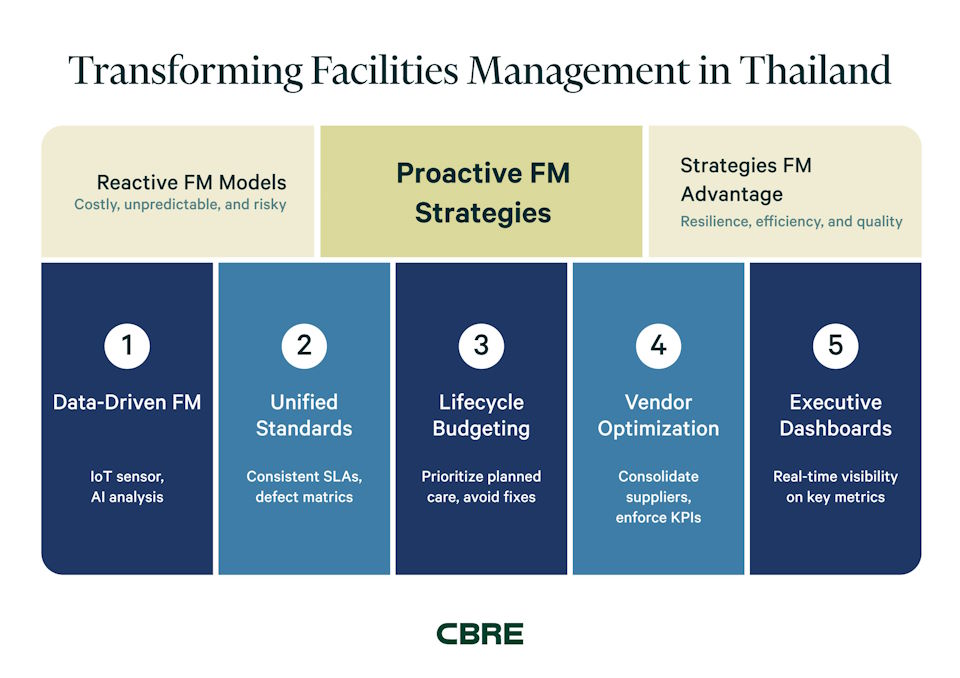
The Imperative Transformation: Data‑Driven Facilities Management in Thailand
In 2025, we saw adoption of IoT (Internet of Things) sensors, AI-driven analytics and computerized maintenance management systems (CMMS). These technologies act as advanced driver-assist systems, enabling predictive maintenance so operators can anticipate failures before they lead to critical system failures. Forward-thinking businesses in Thailand now use real-time data to trim energy waste, extend asset life and keep costs under control.
- The Pivot: Implement condition-based monitoring and predictive analytics for critical systems as part of your integrated facilities management strategy.
- The Result: Maximized uptime, improved energy efficiency and extended equipment lifespan.
CBRE: Driving Excellence in Thailand
Beyond simple maintenance, CBRE provides the stability property owners need to navigate Thailand's evolving real estate landscape. We pair technical rigor with an uncompromising safety culture. In fact, our commitment to Zero Incidents has earned us industry recognition, including the “Contractor of the Year: Best Safety Company” award from a major Thai oil and gas corporation. This foundation of safety and technical precision defines our Global Workplace Solutions (GWS) offerings.
Today’s business climate also demands high-performance portfolios where sustainability is a core metric, not an afterthought. As your strategic partner for integrated facilities management (IFM) in Thailand, we use advanced CMMS technology to track consumption and drive ESG performance.
At CBRE Thailand, we lead by example; our head office at One City Centre in Bangkok is a benchmark for healthy, sustainable workplaces, holding:
- WELL Platinum Certification (April 2025) [Learn more]
- LEED Platinum Certification (November 2025) [Learn more]
- Green Office Gold (November 2025) [Learn more]
Lessons Learned in Facilities Management in Thailand
The past year revealed recurring challenges that slowed facilities management performance. Here’s what we faced and how to steer clear:
- Inconsistent standards: Implement a unified facilities management playbook with service level agreements (SLAs) and defect matrices for comparable performance across sites.
- Poor asset data: Standardize asset registers and maintenance regimes for accurate planning and risk control.
- Misaligned budgets: Apply lifecycle principles to avoid deferred costs and lower total cost of ownership.
- Vendor fragmentation: Consolidate suppliers and enforce KPI (key performance indicator) governance for better service quality and accountability.
- Limited visibility: Deploy dashboards as your facilities management GPS—guiding leaders with real-time visibility on uptime, compliance and spend vs. plan for a smoother operation. This is a major challenge for facilities management in Thailand, as portfolios aim for consistency.
What’s Next for 2026: Strategies for FM Leaders in Thailand
As we shift into 2026, facilities management leaders must embrace strategies that deliver resilience, efficiency and quality. The following priorities will define success for facilities management in Thailand:
- Portfolio‑standard governance: Reduce variability through consistent SLAs and audits.
- Lifecycle‑focused budgeting: Prioritize planned care over reactive emergency fixes.
- Enhanced compliance: Strengthen resilience with audit‑ready documentation.
- Vendor optimization: Consolidate facilities management providers to deliver better outcomes.
- Executive dashboards: Translate complex data into actionable leadership insights.
- Talent investment: Implement staffing strategies and continuous professional development.
- International standards: Maintain certifications (like ISO) to demonstrate a commitment to quality, environmental responsibility and/or safety.
- ESG certifications: Exemplify leadership in healthy, green workplaces through certifications like WELL and LEED.
For Landlords: Protect Asset Value
Landlords must safeguard property value and tenant satisfaction through proactive measures:
- Standardize governance to stabilize performance across portfolios.
- Invest in preventive maintenance to avoid costly failures and downtime.
- Make risk visible through compliance dashboards and audits.
For Corporate Occupiers: Ensure Continuity
Corporate occupiers in Thailand need facilities management strategies that align with business continuity and employee safety:
- Embed condition-based maintenance for critical systems to preempt operational disruptions.
- Consolidate the vendor footprint to improve response speeds, accountability and cost efficiency.
- Align facility operations with core business KPIs, focusing on uptime, safety and sustainability.
Partnering for Success
When a strategic facilities management partner achieves metrics like 99% retention, it’s a clear indicator of profound market confidence. Leading providers of facilities management in Thailand, like CBRE, act as your pit crew—bringing process discipline, tech visibility and vendor control to deliver safety, efficiency, and long-term savings. By leveraging expertise and advanced tools, businesses can shift facilities management from a reactive function into a strategic advantage. Contact CBRE today to explore how our Global Workplace Solutions can transform your portfolio in Thailand.Frequently Asked Questions (FAQ)
What are the latest trends in facilities management in Thailand?
Key trends include the shift from reactive to predictive maintenance, the adoption of AI and IoT technologies for data-driven decisions, and a strong focus on sustainability and ESG compliance to optimize costs. These are currently the dominant Thailand facilities management trends.Why is predictive maintenance important in Thailand’s facilities management sector?
Predictive maintenance helps businesses avoid unplanned downtime and expensive emergency repairs. By using data to anticipate failures, companies can extend asset lifespans and control lifecycle costs more effectively.How can integrated facilities management in Thailand help my business?
Integrated facilities management consolidates vendors and standardizes governance. This results in better service quality, reduced risk and improved operational efficiency across your entire real estate portfolio.Read More:
Facilities Management in Thailand: Escaping the Cycle of Reactive Spending
Transforming Facilities Management in Thailand