Article | Intelligent Investment
Integrated Facilities Management in Thailand for International School Safety
July 3, 2026

For many internationally mobile families, the decision criteria now extend beyond curriculum and reputation. Alongside established academic offerings such as the International Baccalaureate (IB) and Cambridge pathways, parents increasingly value a campus that is demonstrably safe, professionally managed through integrated facilities management in Thailand, and capable of supporting student wellbeing every day.
Meeting that expectation requires a shift from reactive response to a more disciplined, proactive safety model. In practice, this means moving beyond fragmented service delivery toward an integrated facilities management (IFM) approach that brings hard and soft services together under one roof, supporting student welfare, smoother operations and institutional reputation.
Executive Summary: Safety as a Business Strategy
- Market context: As Thailand’s international school market grows more competitive, schools need to differentiate through the full student and parent experience, including the reliability and safety of the campus environment.
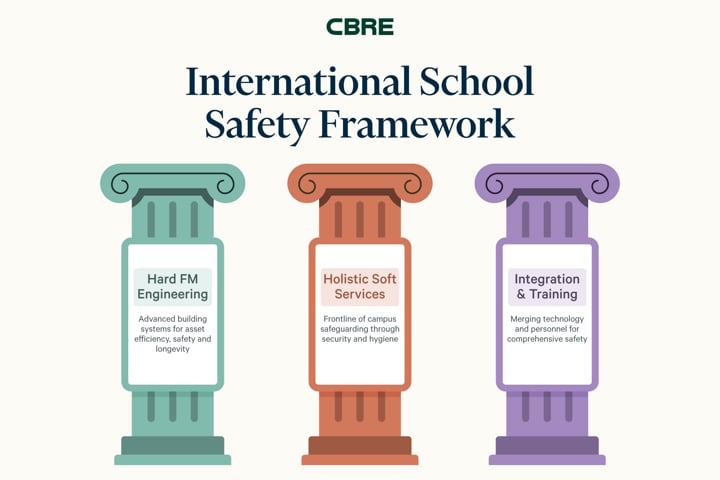
- Pillar 1 — Hard FM engineering: A proactive operating model reduces physical risk through disciplined building standards, including stronger indoor air quality control, temperature-managed water systems and circuit-level electrical protection.
- Pillar 2 — Soft Services: Frontline facility services in Thailand should be designed for a school setting, with robust access control, child safeguarding awareness and hygiene protocols that reduce contamination risk and support continuity of operations.
- Pillar 3 — Integration & Training: A proactive safety model depends on disciplined governance, staff vetting, safeguarding protocols and training-supported systems that strengthen consistency, reduce avoidable disruption and improve response readiness across the campus.
- Strategic outcome: Proactive school facilities management in Thailand should be viewed not simply as an operating cost but as a means of protecting assets, reducing avoidable disruption and strengthening stakeholder confidence in the institution.
The Power of Integrated Facilities Management in Thailand for Schools: Single-Vendor Accountability vs. Fragmented Sourcing
Managing a premium international school campus through fragmented, single-service vendors creates dangerous operational blind spots, administrative fatigue and volatile maintenance costs. By transitioning to an integrated facilities management (IFM) model, institutions replace a chaotic web of separate contracts with a single, accountable strategic partner. This unified approach eliminates vendor finger-pointing, aligns both hard engineering and soft janitorial services under a single governance standard, and drives significant cost efficiencies through economies of scale.More importantly, IFM shifts campus operations from a reactive "break-fix" cycle to a data-driven, predictive model. For school leadership, this transforms facilities from an unpredictable overhead expense into something that actively builds the school's reputation, helping with safeguarding compliance and day-to-day reliability—both of which influence recruitment and retention.
Pillar 1: Hard FM Engineering
In an international school setting, building systems need to be designed and operated with greater sensitivity than in a conventional office environment. Air quality, water temperature, electrical protection and outdoor play areas all have a direct bearing on student safety, wellbeing and continuity of learning.Indoor Air Quality (IAQ) & Positive Pressure
Thailand’s seasonal PM2.5 conditions underline the importance of a structured indoor air quality strategy. Rather than relying solely on standalone devices, schools can benefit from ventilation and filtration approaches that help limit the ingress of outdoor pollutants while maintaining classroom conditions that support comfort and concentration.Industry Benchmark: While standard guidelines suggest CO2 limits of 1,000 ppm, premium educational facilities often align with the WELL Building Standard, which requires CO2 to be kept below 800 ppm to support cognitive performance.
Electrical & Water Safety: Deconstructing the RCBO Standard
Children’s environments require risk controls that are designed into the infrastructure. For water systems, thermostatic mixing valves can help maintain safe outlet temperatures at hand-washing points. For electrical systems, higher-sensitivity protection at child-accessible outlets provides an additional layer of protection against shock, overload and localized faults.Industry Benchmark: Water above 44°C can cause severe thermal burns on a child's skin in seconds. The U.K. Health and Safety Executive (HSE) mandates that TMVs restrict hot water temperatures to a maximum of 38°C for early years settings.
RCBOs are particularly relevant in school environments because they combine life-safety protection with equipment and fire risk management. They also support fault isolation, allowing a local issue to be contained without unnecessarily affecting adjacent classrooms or wider building operations.
- Life Protection (Residual Current): Senses if electricity is escaping the circuit, such as when a child tampers with an outlet. It detects this tiny imbalance and cuts power within 30 milliseconds, before a shock becomes fatal.
- Asset Protection (Overload & Short Circuit): Instantly cuts power if a circuit is overloaded by too many devices or experiences a direct short circuit, preventing electrical fires.
By deploying dedicated RCBOs on a per-classroom basis rather than relying on one large traditional RCD safety switch for an entire floor, schools achieve precise fault isolation. If an appliance malfunctions in one room, only that specific circuit trips. The rest of the floor, the lighting systems and adjacent classrooms remain fully live and operational.
Engineering Playground Audits
Playgrounds should also be managed as engineered safety environments rather than purely recreational spaces. Inspection frequencies, impact attenuation performance and surface condition checks should be clearly defined and aligned to the relevant standard and risk profile of the campus.Engineering & Environmental Standards for International Campus Safety
| System | Proactive Metric | Mitigated Risk |
| AIR QUALITY (IAQ) | CO2 below 800 PPM & near-zero PM2.5 | Allergies, asthma, cognitive fatigue |
| WATER SAFETY | Max temperature locked at 38°C via TMV | Thermal burns (scalding) in children |
| ELECTRICAL | High-sensitivity individual RCBOS per circuit | Electrocution and widespread building power outages |
| LIGHTING | 300–500 LUX (glare-free) | Eye strain and impaired visual development |
| PLAYGROUND STRUCTURE | Daily/weekly rubber pad audits | Severe impacts and fractures from falls |
Pillar 2: Holistic Soft Services
If hard FM provides the physical framework, soft services shape the day-to-day operating environment experienced by students, staff and parents. In premium school settings, this includes access control, cleaning protocols, landscaping and frontline behaviors that align with child safeguarding expectations.1. Security Services: Layered Perimeters
- Access Control & Zoning: A clearly defined zoning strategy helps separate public-facing areas from secure student spaces. Technology-enabled access controls can strengthen perimeter integrity and improve the management of authorized entry.
- Behavioral Monitoring: Security personnel in school environments should be trained to operate within child safeguarding protocols, with a focus on observation, escalation and prevention rather than simple gatekeeping.
2. Cleaning & Janitorial: Non-Toxic Hygiene
- Chemical Safety: Cleaning products should be selected with student exposure in mind, prioritizing low-toxicity and low-VOC formulations aligned to recognized standards where appropriate.
- Advanced Cross-Contamination Prevention: A strict color-coded system is vital. Equipment used in restrooms (red) must never enter a cafeteria (green) or classroom (blue). This standard is endorsed by the British Institute of Cleaning Science (BICSc).
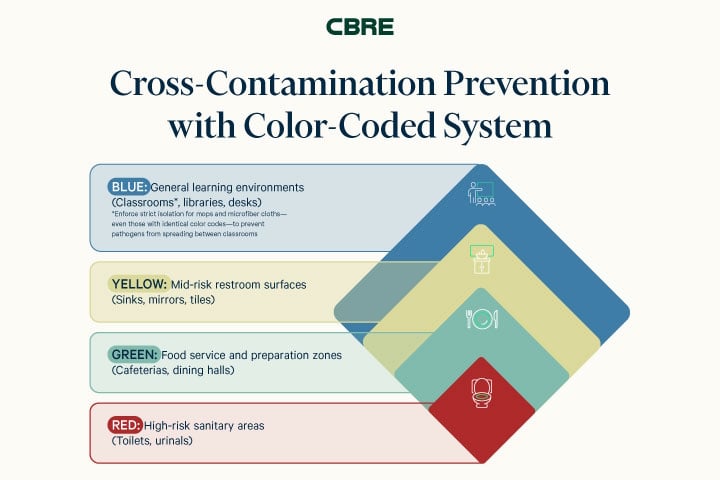
- Classroom-Specific Hygiene Controls: In higher-risk settings, separating cloths and mop heads by room or zone can help reduce the possibility of cross-contamination between learning spaces.
- Seasonal Infection Control: During periods of elevated health risk, targeted disinfection of high-touch areas can support a broader infection prevention strategy and reduce operational disruption.
3. Landscaping: Natural Play Safety
Flora Vetting: Landscaping choices should reflect the needs of a child-occupied environment, including the avoidance of hazardous plant species and routine review of outdoor areas for emerging risks.Pillar 3: Integration & Training
The effectiveness of a proactive safety model depends not only on systems and equipment, but also on governance, training and operational discipline. Technology is most valuable when supported by personnel who understand the specific requirements of an international school environment.-
Vetting & Background Checks: Schools should apply robust pre-engagement screening for staff and contractors in line with local regulations and safeguarding policies.
- Predictive Systems via CMMS: Integrating a computerized maintenance management system with sensor-based monitoring can improve visibility of asset condition, support planned intervention and reduce avoidable disruption to teaching spaces.
- Safeguarding Protocols for Frontline Personnel: All support personnel should operate within clearly defined safeguarding rules, escalation pathways and supervision requirements appropriate for student-facing environments.
From Operating Cost to Institutional Confidence
For school boards, senior leaders and investors, the broader implication is clear: a proactive approach to campus safety and facilities management can contribute to stronger asset stewardship, lower avoidable risk and greater confidence among parents and other stakeholders.For institutions seeking to strengthen resilience and service quality, integrated facilities management should be considered part of the wider operating strategy rather than a standalone maintenance function.
For organizations evaluating their current campus operating model, this creates an opportunity to benchmark existing practices against higher safety, compliance and service standards.
Contact CBRE GWS today to optimize your building's operational efficiency and elevate your institution to world-class safety benchmarks.
Key Takeaways: Integrated Facilities Management in Thailand
- Integrated facilities management in Thailand enables a proactive safety model, reducing reliance on fragmented vendors and reactive maintenance.
- Hard FM engineering controls, from IAQ to RCBO deployment, directly reduce physical risk in school environments.
- Soft services play a critical safeguarding role, supporting hygiene standards, access control and student wellbeing.
- Technology integration (CMMS and predictive systems) improves visibility, reduces downtime and enhances operational continuity.
- Single-vendor IFM models strengthen accountability, cost efficiency and governance consistency across campus operations.
- Facilities management is no longer an operational cost center but a strategic lever for institutional trust, parent retention and long-term asset protection.
Strategic FAQ for Educational Executives
Q1: What is integrated facilities management in Thailand for schools?
A: Facilities management for schools refers to the coordinated delivery of hard and soft services—engineering maintenance, security, cleaning, environmental controls—to ensure campus environments stay safe, compliant and supportive of learning.Q2: Why is integrated facilities management important for international schools in Thailand?
A: Integrated facilities management puts all campus operations under one accountable model instead of several disconnected vendors, which reduces risk and improves day-to-day efficiency. In Thailand's competitive international school market, it also supports more consistent safeguarding and a stronger overall experience for students and parents.Q3: How does shifting from reactive to proactive facilities management impact an international school's ROI?
A: A proactive model tends to mean fewer unplanned repair costs, longer asset life and fewer preventable incidents. It also gives parents and boards a clearer signal that risk, continuity and day-to-day operations are being managed with real discipline.Q4: Why is proactive IAQ management a critical metric for academic success?
A: Indoor air quality influences comfort, concentration and the overall learning environment. Maintaining appropriate ventilation and CO2 levels supports student attentiveness and the conditions needed for consistent academic delivery.Q5: How does a color-coded cleaning system protect business continuity?
A: Color-coding and room-based equipment separation reduce the risk of cross-contamination. In periods of elevated illness risk, these measures can support continuity by limiting avoidable spread within shared environments.Q6: Are ASTM standards necessary for outdoor play areas in Thailand's climate?
A: Yes. Climate conditions accelerate wear in outdoor materials and surfacing systems. Using recognized playground standards and a defined inspection regime helps schools maintain safer play environments and manage deterioration more systematically.
Read More:
Facilities Management in Thailand: Solving the Technical Debt Crisis
The Second Life Strategy: Navigating Facilities Management in Thailand
Driving ESG Success Through Facilities Management in Thailand
Disclaimer:
At CBRE, we prioritize the accuracy and integrity of our market information. While we use generative AI tools to assist in the composition and optimization of its presentation, all information is based on proprietary research and the profound insights from our experienced property professionals. Every article undergoes a thorough human review and fact-check to ensure it meets our standards for professional quality and technical accuracy.