Article | Intelligent Investment
Achieve Zero Incidents with Effective Facility Management in Thailand
February 10, 2026
Achieving Safety Excellence and Business Resilience
Facilities management in Thailand is the strategic integration of people, place and process to ensure a safe and productive built environment. In today’s competitive landscape, navigating Thailand’s regulatory environment—specifically the Occupational Safety, Health and Environment Act, B.E. 2554—is the essential baseline for operational success.Beyond the B.E. 2554 Act, facilities management in Thailand must also account for the Department of Labor Protection and Welfare (DLPW) regulations and the Building Control Act. For multinational firms operating in Thailand, the challenge is often bridging the gap between stringent global corporate standards and local statutory requirements. A sophisticated facilities management partner ensures that fire safety certifications, electrical system inspections and boiler permits are not just "on file," but are integrated into a live preventive maintenance schedule.
For COOs and CFOs, achieving "Zero Incidents" is a strategic driver for resilience and profitability. Facilities management in Thailand transforms safety from a regulatory burden into a value-driven discipline by protecting people, ensuring business continuity and building brand trust. The challenge? Embedding proactive safety into everyday facility operations. This is where facilities management providers in Thailand become a strategic partner, moving beyond simple compliance to create a culture where safety actively powers the bottom line.
The Business Impact of Zero Incidents Through Facilities Management in Thailand
When an organization commits to zero incidents through a robust integrated facilities management model, the benefits strengthen the bottom line across four key areas:- Cost Reduction: Fewer incidents lead to lower medical claims and repair costs. Data from the Thai Workmen’s Compensation Fund (WCF) shows that consistent safety improvements have helped reduce industrial injury rates from 31.4 to 16.5 per 1,000 workers, showcasing the immense financial benefit of proactive risk control. Furthermore, a reduction in incident frequency can lead to lower insurance premiums and a significant decrease in "hidden" costs, such as administrative time spent on accident investigations.
- Operational Continuity: Safe environments prevent unplanned downtime. This stability allows employees to focus on output and efficiency. When critical infrastructure—such as HVAC or electrical systems—is managed under a zero-incident framework, the risk of catastrophic failure is minimized, ensuring that production lines and office hubs remain fully functional around the clock.
- Risk Mitigation: Avoid severe legal penalties and litigation risks associated with accidents or non-compliance under local safety laws. In Thailand’s tightening regulatory climate, proactive facilities management serves as a shield against the reputational and financial fallout of Ministry of Labor audits, ensuring that every site remains fully licensed and compliant with evolving safety codes.
- Talent and Reputation: Safety excellence attracts and retains top talent, reinforcing your brand as a responsible market leader. In a competitive labor market, a demonstrably safe workplace becomes a core part of the employee value proposition (EVP), fostering a high-trust culture that reduces turnover and positions the company as an ethical benchmark for global partners.
Key Insight: Think of facilities management as the "central nervous system" of your portfolio. A safe environment is the only reliable environment.
Facilities Management in Thailand: A Foundation for Zero-Incident Culture
Teams providing facilities management in Thailand are on the front lines of risk. Moving beyond reactive maintenance requires addressing systemic weaknesses:
- Human Factors: Inconsistent adherence to safe work procedures, fatigue or lack of training.
- Asset Conditions: Poorly maintained assets, inadequate housekeeping or faulty infrastructure.
- Management Gaps: Insufficient risk assessments or weak safety leadership, particularly in contractor oversight.
- Environmental Risks: Weather hazards, confined spaces and chemical exposure.
Academic research from Dodoo & Al-Samarraie (2021) highlights that systemic failures are root causes of accidents. Proactive facilities management acts as the authority to correct these failures before they escalate.
CBRE’s Proven Leadership in Facilities Management Safety
Engaging an established and reliable facilities management provider like CBRE is one of the most effective ways to achieve zero incidents. Our facilities management excellence is built on proven, measurable processes.CBRE’s facilities management team recently demonstrated this commitment by achieving the prestigious "Best Safety Company for Contractor of the Year 2024" award from Leading Thai Oil & Gas at its refinery site in Thailand. This recognition shows the tangible outcome of a sustained, metrics-driven commitment to safety leadership, strict compliance with life-saving rules and a culture that enforces zero injuries.
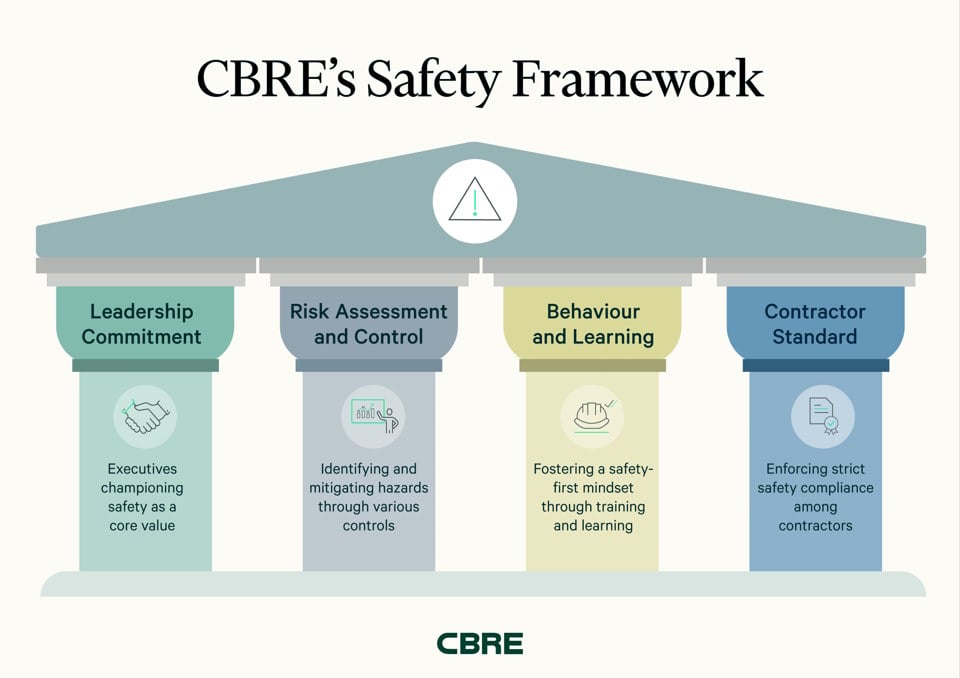
The following is CBRE’s four-pillar framework for zero-incident success:
1. Leadership Commitment: Executives must lead safety from the front—funding, championing and making it a visible core value across all sites.2. Risk Assessment and Control: Identify hazards early and implement controls, including:
• Engineering controls to eliminate hazards through design
• Administrative controls such as clear procedures and permits
• Personal protective equipment (PPE)
3. Behavior and Learning: Foster a safety-first mindset through:
• Regular training and competency programs for employees and contractors
• Behavior-based safety programs encourage safe practices
• Investigating near-misses—every close call is a lesson for continuous improvement
4. Contractor Standards: Contractor safety is often the toughest challenge. CBRE manages this risk by:
• Enforcing strict compliance with life-saving rules
• Maintaining high safety assessment index (SAI) scores for third-party workers
• Engaging in contractor safety committees to uphold standards
This level of rigor ensures that all workers, internal or external, operate at the same level of excellence required to achieve and sustain zero incidents.
FAQ: Facilities Management in Thailand
What is the role of facilities management in Thailand’s workplace safety?
Facilities management in Thailand plays a critical role in workplace safety by overseeing daily operations, maintenance and risk controls. FM teams ensure compliance with Thailand’s Occupational Safety, Health and Environment Act B.E. 2554, conduct safety inspections, and implement preventive maintenance. By identifying risks early, they protect employees and maintain uninterrupted operations.How does integrated facilities management support zero-incident goals?
Integrated facilities management supports zero-incident goals by unifying safety processes, contractor oversight and risk management under one system. This minimizes human error and ensures all staff follow the same safety rules, creating a safer, more reliable environment.Ready to transform your safety culture? Contact CBRE GWS today to learn how our facilities management in Thailand can drive your organization to zero incidents.
Read More:
Facilities Management in Thailand: Key Trends & Lessons
Facilities Management in Thailand: Escaping the Cycle of Reactive Spending